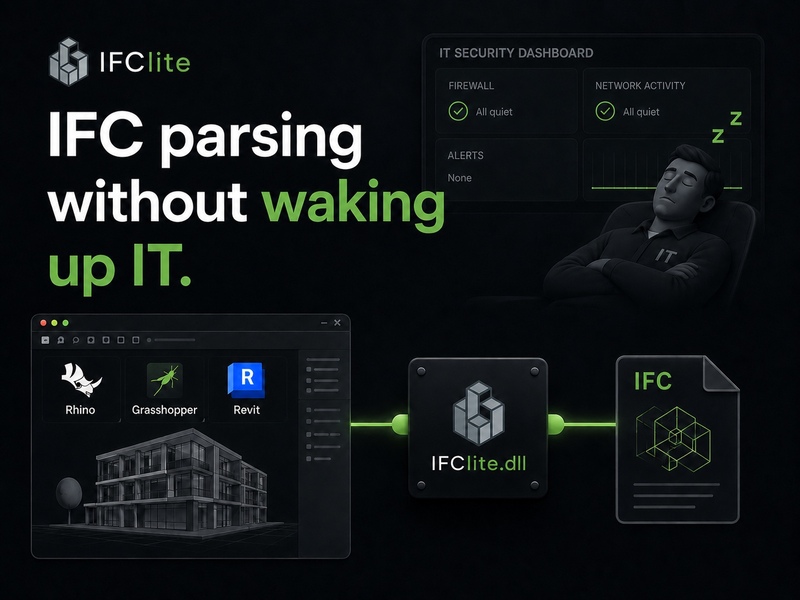
IFClite merged PR #1182, a contribution from Mathias Sønderskov Schaltz that lets IFClite parse IFC inside the CAD process — as a plain DLL.
The clean way to call a Rust engine from Grasshopper or Revit used to mean running a local server and talking to it over HTTP. But the moment something opens a port on a managed machine, enterprise IT lights up: firewall rules, security reviews, the whole dance. The FFI wires IFClite straight into the process instead. A new ifc-lite-ffi crate builds with crate-type = ["cdylib"] to ifc_lite_ffi.dll, and the host loads it like any other library. No server. No port. No network. Just a function call.
The surface is three extern "C" functions. ifc_lite_parse takes a UTF-8 path and writes back a heap buffer of JSON. ifc_lite_parse_ex adds one flag for opening handling — cut all voids, ignore every window and door, or keep only glazed ones. ifc_lite_free hands the buffer back to Rust. Rust allocates, the C# caller frees, exactly once. Failures come back as status codes, not exceptions: 0 ok, 1 bad pointer, 2 unreadable file, 3 parse panic, 4 serialization. The payload is IFClite’s full ParseResponse — per-element meshes, schema metadata, stats, and site and building transforms.
The hard part is making it safe to embed. IFC geometry recurses deep: BSP-tree CSG and walls with hundreds of openings blow past the default ~1 MiB worker stack, and an overflow takes the host down with a bare STACK_OVERFLOW (0xC00000FD) that nothing can catch. So parsing runs in a dedicated rayon pool with 256 MiB stacks, wrapped in catch_unwind so a panic returns code 3 instead of killing Rhino. That only works if panics unwind, so the DLL must build with --profile server-release, which restores panic = "unwind". Every panic also logs to %TEMP%/ifc_lite_panic.log.
The smoke tests followed in PR #1183, and ifc-lite-ffi now ships on crates.io at v4.1.0 under MPL-2.0, ready to P/Invoke from a Grasshopper or Revit add-in. See the pull request and the IFClite project site for details.