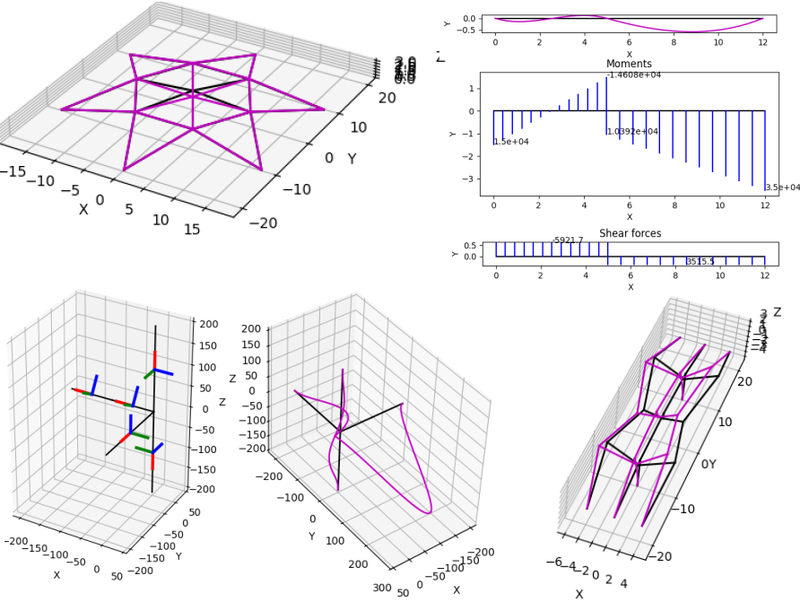
Petr Krysl has announced pystran, an open source Python package for structural analysis. The project started as a learning tool and remains a work in progress, but it already supports a useful set of structures for experimentation, teaching, and feedback from early users.
pystran handles two-dimensional and three-dimensional structures made up of truss and beam members, springs, and rigid bodies. It includes linear statics and free vibration solvers, supports concentrated masses at joints, and has gained rigid links, general springs, tutorials, documentation, and packaging through PyPI since the original community announcement.
The project is intentionally clear about its current limits: only elastic models are solved, beams use a Bernoulli-Euler formulation, members are straight, member loads need to be converted to nodal forces by the user, and several advanced beam and support behaviours are not implemented yet. That makes it especially interesting as an educational and hackable codebase for engineers who want to inspect, teach, or extend structural analysis workflows in Python.
pystran is available under the MIT license and can be installed with pip install pystran.